Egyptian Russian University Enters Global "Times" Ranking for the First Time and Strengthens International Presence in Sustainability.
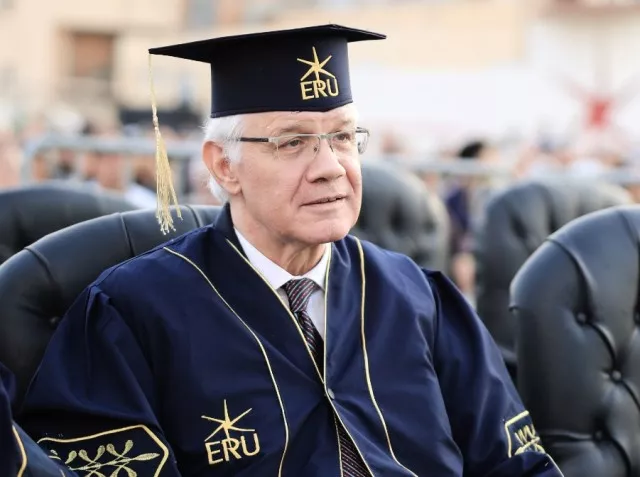
Prof. Dr. Sherif Fakhry, President of the Egyptian Russian University (ERU), announced a significant milestone that reflects the university’s rapid institutional development and bolstering its presence on the international academic stage: its debut in the Times Higher Education (THE) World University Rankings 2027. With this achievement, the ERU joins the 40 Egyptian universities featured in this year’s ranking.
This accomplishment coincides with the university securing 11th place among Egyptian universities in the UI GreenMetric World University Rankings for sustainable universities 2026. These results underscore the university’s growing prominence in international rankings across various domains—including academic and research performance, sustainability, using resources efficiency, and institutional practices that support sustainable development.
Prof. Dr. Sherif Fakhry emphasized that the significance of these results extends beyond mere numerical rankings; they reflect a progressive evolution in the university’s institutional performance system. This marks a shift toward a more comprehensive model that integrates educational quality, robust and impactful scientific research, knowledge transfer, internationalization, sustainability, resource efficient use, governance, and digital transformation, all while delivering tangible social and economic impact.
He explained that the next phase requires shifting the focus from merely increasing the volume of research output to maximizing its quality and international impact. This is to be achieved by fostering local and international research collaborations and partnerships, and by supporting the translation of scientific research outcomes into patents, products, and applied solutions with economic and societal value. Such efforts will enhance the university’s international competitiveness and align with the requirements of third- and fourth-generation universities, the Sustainable Development Goals, and Egypt’s Vision 2030.
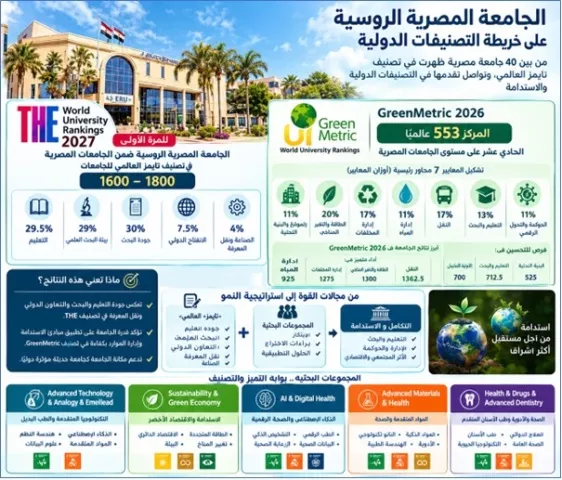
Prof. Dr. Essam Khamis, Advisor to the University President for Academic Development, further explained that the university’s inclusion in the THE rankings represents more than just a numerical position; it reflects an assessment of performance across five key pillars: Teaching, Research Environment, Research Quality, International Outlook, and Industry & Knowledge Transfer. The 2027 ranking methodology relies on 17 performance indicators, with Research Quality carrying the highest single weight at 30%—encompassing citation impact, research strength, research excellence, and research impact. Meanwhile, the weights assigned to the other pillars are 29% for Research Environment, 29.5% for education, 7.5% for International Outlook, and 4% for Industry & Knowledge Transfer.
He noted that the implications of this methodology extend beyond measuring the volume of scientific output to evaluating its quality, impact, and capacity to establish an international presence and transfer knowledge to society and the economy. Consequently, the upcoming phase demands enhancing the quality and impact of research outputs, strengthening international research partnerships and collaborations, and maximizing their utility through patents, utility models, products, and applied solutions.
He explained that the UI GreenMetric results add another dimension to the overall picture; the ranking measures the university’s ability to build a sustainable campus, manage resources efficiently, and embed sustainability into education, research, and institutional practices. The GreenMetric 2026 methodology encompassed seven key categories—Setting and Infrastructure, Energy and Climate Change, Waste Management, Water Management, Transportation, Education and Research, and Governance and Digital Transformation—with respective weightings of 11%, 20%, 17%, 11%, 17%, 13%, and 11%.
The university achieved a score of 6,800 points in GreenMetric 2026, demonstrating outstanding performance in the categories of Transportation (1,362.5 points), Energy and Climate Change (1,300 points), Waste Management (1,275 points), and Water Management (925 points). Conversely, the results highlight areas offering significant opportunities for further development—specifically Infrastructure (525 points), Education and Research (712.5 points), and Governance and Digital Transformation (700 points). This provides the university with clear indicators to guide future efforts toward the areas most impactful for improving performance and enhancing institutional sustainability.
He emphasized that integrating the THE and GreenMetric results offers a more comprehensive view of the university’s development trajectory; while the THE ranking reflects its competitiveness in education quality, scientific research, international collaboration, and knowledge transfer, GreenMetric highlights its capacity to implement sustainability principles, manage resources efficiently, and embed these practices within the institutional framework. This integration underscores the university’s attitude to build a comprehensive model of a modern university—one that is capable of generating and utilizing knowledge, and transforming it into sustainable scientific, economic, and societal value.
He added that the university’s strategic direction for the coming phase aims not merely to improve its standing in international rankings, but to utilize these rankings and their associated indicators to identify areas requiring improvement and support through an institutional framework; this ensures that any rise in the university’s ranking becomes a natural outcome of genuine progress in education, research, innovation, sustainability, and knowledge transfer.
This accomplishment coincides with the university securing 11th place among Egyptian universities in the UI GreenMetric World University Rankings for sustainable universities 2026. These results underscore the university’s growing prominence in international rankings across various domains—including academic and research performance, sustainability, using resources efficiency, and institutional practices that support sustainable development.
Prof. Dr. Sherif Fakhry emphasized that the significance of these results extends beyond mere numerical rankings; they reflect a progressive evolution in the university’s institutional performance system. This marks a shift toward a more comprehensive model that integrates educational quality, robust and impactful scientific research, knowledge transfer, internationalization, sustainability, resource efficient use, governance, and digital transformation, all while delivering tangible social and economic impact.
He explained that the next phase requires shifting the focus from merely increasing the volume of research output to maximizing its quality and international impact. This is to be achieved by fostering local and international research collaborations and partnerships, and by supporting the translation of scientific research outcomes into patents, products, and applied solutions with economic and societal value. Such efforts will enhance the university’s international competitiveness and align with the requirements of third- and fourth-generation universities, the Sustainable Development Goals, and Egypt’s Vision 2030.
Prof. Dr. Essam Khamis, Advisor to the University President for Academic Development, further explained that the university’s inclusion in the THE rankings represents more than just a numerical position; it reflects an assessment of performance across five key pillars: Teaching, Research Environment, Research Quality, International Outlook, and Industry & Knowledge Transfer. The 2027 ranking methodology relies on 17 performance indicators, with Research Quality carrying the highest single weight at 30%—encompassing citation impact, research strength, research excellence, and research impact. Meanwhile, the weights assigned to the other pillars are 29% for Research Environment, 29.5% for education, 7.5% for International Outlook, and 4% for Industry & Knowledge Transfer.
He noted that the implications of this methodology extend beyond measuring the volume of scientific output to evaluating its quality, impact, and capacity to establish an international presence and transfer knowledge to society and the economy. Consequently, the upcoming phase demands enhancing the quality and impact of research outputs, strengthening international research partnerships and collaborations, and maximizing their utility through patents, utility models, products, and applied solutions.
He explained that the UI GreenMetric results add another dimension to the overall picture; the ranking measures the university’s ability to build a sustainable campus, manage resources efficiently, and embed sustainability into education, research, and institutional practices. The GreenMetric 2026 methodology encompassed seven key categories—Setting and Infrastructure, Energy and Climate Change, Waste Management, Water Management, Transportation, Education and Research, and Governance and Digital Transformation—with respective weightings of 11%, 20%, 17%, 11%, 17%, 13%, and 11%.
The university achieved a score of 6,800 points in GreenMetric 2026, demonstrating outstanding performance in the categories of Transportation (1,362.5 points), Energy and Climate Change (1,300 points), Waste Management (1,275 points), and Water Management (925 points). Conversely, the results highlight areas offering significant opportunities for further development—specifically Infrastructure (525 points), Education and Research (712.5 points), and Governance and Digital Transformation (700 points). This provides the university with clear indicators to guide future efforts toward the areas most impactful for improving performance and enhancing institutional sustainability.
He emphasized that integrating the THE and GreenMetric results offers a more comprehensive view of the university’s development trajectory; while the THE ranking reflects its competitiveness in education quality, scientific research, international collaboration, and knowledge transfer, GreenMetric highlights its capacity to implement sustainability principles, manage resources efficiently, and embed these practices within the institutional framework. This integration underscores the university’s attitude to build a comprehensive model of a modern university—one that is capable of generating and utilizing knowledge, and transforming it into sustainable scientific, economic, and societal value.
He added that the university’s strategic direction for the coming phase aims not merely to improve its standing in international rankings, but to utilize these rankings and their associated indicators to identify areas requiring improvement and support through an institutional framework; this ensures that any rise in the university’s ranking becomes a natural outcome of genuine progress in education, research, innovation, sustainability, and knowledge transfer.